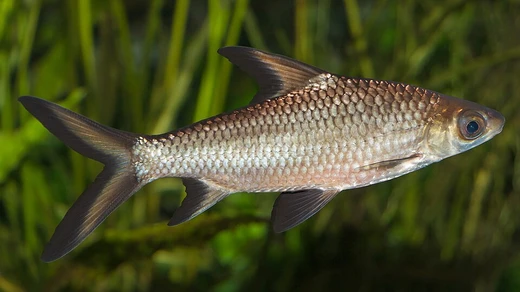
Galaxiidae
Small freshwater fish of the Southern Hemisphere, many amphidromous.

The Galaxiidae are a family of mostly small freshwater fish in the Southern Hemisphere. The majority live in Southern Australia or New Zealand, but some are found in South Africa, southern South America, Lord Howe Island, New Caledonia, and the Falkland Islands. One galaxiid species, the common galaxias (Galaxias maculatus), is probably the most widely naturally distributed freshwater fish in the Southern Hemisphere. They are coolwater species, found in temperate latitudes, with only one species known from subtropical habitats. Many specialise in living in cold, high-altitude upland rivers, streams, and lakes.
- Family
- Galaxiidae
- Number of species
- About 50
- Genera
- 7 (including disputed †Stompooria)
- Distribution
- Southern Hemisphere (Australia, New Zealand, South Africa, South America, Falkland Islands, Lord Howe Island, New Caledonia)
- Known for
- Amphidromous lifecycle; threatened by exotic salmonids
- Earliest definitive fossils
- Miocene of New Zealand
Lore & Background
Some galaxiids live in fresh water all their lives, but many have a partially marine lifecycle. In these cases, larvae are hatched in a river, but are washed downstream to the ocean, later returning to rivers as juveniles to complete their development to full adulthood. This pattern differs from that of salmon, which only return to fresh water to breed, and is described as amphidromous. Freshwater galaxiid species are threatened, some gravely, by exotic salmonid species, particularly trout species, which prey upon galaxiids and compete with them for food. Exotic salmonids have been introduced by humans to many different land masses (e.g. Australia, New Zealand), with little apparent thought as to ecological impacts on native fish. Numerous localised extinctions of galaxiid species have been caused by the introduction of exotic salmonids, and a number of freshwater galaxiid species are threatened with overall extinction by exotic salmonids.
Reader's Guide
Phylogenetic evidence alternatively places galaxiids within the Protacanthopterygii, or more recently as the sister group to the Neoteleostei. Their ancestors are thought to have diverged from the neoteleosts around the Triassic-Jurassic boundary. The earliest definitive fossils of galaxiids are from the Miocene of New Zealand, which can be placed in the extant genus Galaxias. This young fossil range contrasts with the presumed ancient origins of the group. However, later studies have questioned this assignment, as Stompooria differs from galaxiids in many morphological traits, especially in the presence of scales, although it being an ancestral galaxiid that had not yet developed galaxiid traits could not be ruled out. Many galaxiid genera show an unusual form of sister group relationship to one another, where a genus in Australasia is more closely related to a genus in South America than to other genera from the same continent. It is thought that the evolution of galaxiids may have been influenced by the Antarctic land bridge between Australia and South America, which served as a shallow marine and fresh water connection that allowed different galaxiid taxa to disperse between both continents.
Did You Know?
- One galaxiid species, the common galaxias (Galaxias maculatus), is probably the most widely naturally distributed freshwater fish in the Southern Hemisphere.
- Many galaxiids have an amphidromous lifecycle: larvae hatch in rivers, go to the ocean, and return as juveniles.
- Freshwater galaxiids are threatened by exotic salmonids, particularly trout, which prey on them and compete for food.
- The earliest definitive galaxiid fossils are from the Miocene of New Zealand, placed in the extant genus Galaxias.
More in Fish 1-24
Elsewhere in the Fish universe
Spotted an error? Know more?
This is a living reference — every entry is fact-audited, and reader corrections feed straight into our audit queue. Suggest an edit · See this site's audit record