Anglerfish
Ray-finned fish using a modified fin ray as a lure.

Randel Kreitsberg · CC BY 4.0
Anglerfish are ray-finned fish in the order Lophiiformes, named for their characteristic mode of predation in which a modified dorsal fin ray acts as a lure for prey. They occur worldwide, with most being bottom-dwelling demersal fish, while deep-sea anglerfish are pelagic. Anglerfish are notable for extreme sexual dimorphism, with females sometimes several orders of magnitude larger than males, enabling a unique reproductive method called sexual parasitism in deep-sea species. Some anglerfish are of commercial value, particularly lophiid anglerfish marketed as monkfish or goosefish, whose meat is considered a delicacy.
- Scientific name
- Lophiiformes
- Earliest fossils
- Eocene, from Monte Bolca formation, Italy
- Largest species
- European monkfish Lophius piscatorius (200 cm SL, 57.7 kg)
- Smallest known male
- Photocorynus spiniceps (6.2–7.3 mm at maturity)
- Key feature
- Modified dorsal fin ray (illicium and esca) used as a lure
Lore & Background
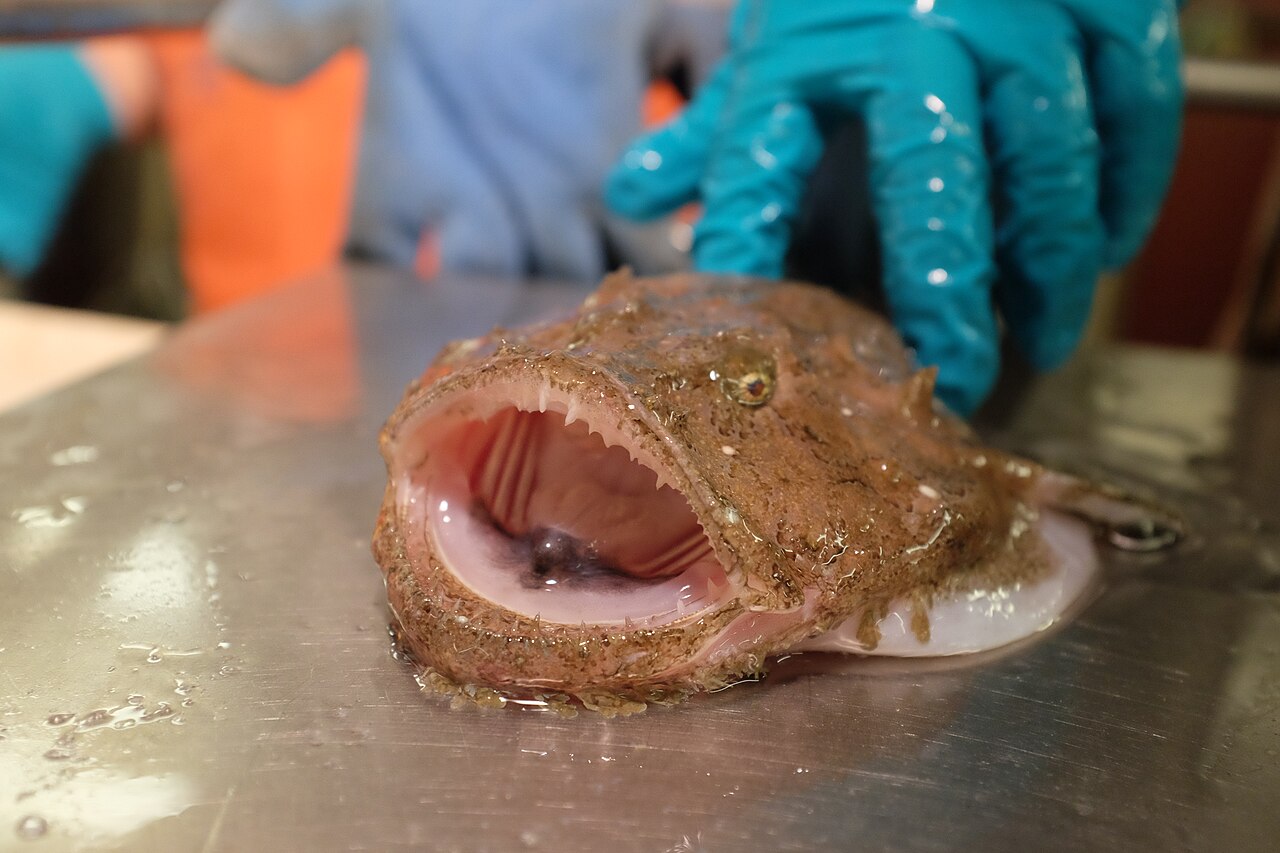
The earliest fossils of anglerfish are from the Eocene, excavated from the Monte Bolca formation of Italy, already showing evidence of diversification into modern families. Given their close relationship to Tetraodontiformes, which are known from Cretaceous fossils, they likely originated during the Cretaceous. Other studies indicate origin shortly after the Cretaceous-Paleogene extinction event, though this clashes with Eocene diversity. Anglerfish are defined by gills that open behind the pectoral fins, depressible teeth, joints of the epiotic bone, the form of pectoral fin radials, and the luring apparatus. Sizes range dramatically: many species exceed 18 cm, the largest surpass 200 cm, and the smallest mature males can be just millimeters long. Sexual dimorphism is most extreme in deep-sea anglerfish; male Ceratias holboelli typically reach only 1–3 cm standard length, while females can grow up to about 120 cm total length. Male Photocorynus spiniceps were measured at 6.2–7.3 mm at maturity, once claimed the smallest vertebrate, but are now often excluded from records due to being parasitic males. Shallow-water species such as frogfish often camouflage as rocks, sponges, or seaweed, while deep-sea anglerfish are dark colored to blend in with the deep sea.
Reader's Guide
Anglerfish hold significance as a striking example of evolutionary adaptation, particularly in their predatory lure and extreme sexual dimorphism. The order Lophiiformes includes both shallow-water and deep-sea species, with the deep-sea anglerfish exhibiting sexual parasitism, where males attach to females and fuse as natural parabiosis. This reproductive method is unique among vertebrates and has been a subject of scientific study. The group's commercial value is notable: lophiid anglerfish (monkfish, goosefish) are prized for their meat, considered a delicacy throughout their range, while some species are of interest to aquaria. Phylogenetically, anglerfish are consistently recovered as sister-group to Tetraodontiformes within the larger clade Acanthuriformes, united by derived features such as restricted gill openings and absence of multiple skeletal elements. The fossil record shows anglerfish already diversified by the Eocene, indicating a Cretaceous origin, though the timing of their radiation remains debated. Their adaptations to different depth ranges may have driven species and family evolution in prehistory. The classification of anglerfish has evolved from Cuvier's early grouping through Pediculati to the modern Lophiiformes, with ongoing phylogenetic studies refining relationships among suborders and families.
Did You Know?
- The modified dorsal fin ray used as a lure consists of the illicium (the stalk) and the esca (the tip).
- Male Photocorynus spiniceps were once claimed to be the smallest known vertebrate, measuring 6.2–7.3 mm at maturity.
- The earliest anglerfish fossils are from the Eocene, found in the Monte Bolca formation of Italy.
- Deep-sea anglerfish exhibit sexual parasitism, where males attach to females and sometimes fuse together as natural parabiosis.
The Lure: A Fin Ray Turned Fishing Rod
The anglerfish's most iconic feature is a modified dorsal fin ray that functions as a lure, giving the group its name in both common and scientific form (Lophiiformes, from the Greek "lophos" meaning crest). The structure has two named parts: the illicium, which is the length of the stalk, and the esca, the very tip that dangles like bait. Across the many families within the order, this apparatus has been refined to attract different prey items using different luring strategies, much as a human angler might switch lures for different species. This single anatomical modification is so central to the group's identity that it anchors both their taxonomic name and their ecological niche. Whether a frogfish in shallow tropical waters or a deep-sea seadevil in the abyss, the illicium-esca system is the thread that ties all anglerfish together as a coherent order.
Love in the Abyss: Sexual Parasitism and Extreme Dimorphism
Among the deep-sea anglerfish, sexual dimorphism reaches a degree almost unimaginable in the animal kingdom: females can outweigh males by several orders of magnitude. This extreme size gap has enabled a reproductive strategy known as sexual parasitism, in which the tiny male attaches to the much larger female and may ultimately fuse with her body — a phenomenon scientists call natural parabiosis. The male essentially becomes a permanent sperm-producing organ, while the female carries the burden of finding food and producing offspring in the vast, food-scarce deep ocean. This arrangement is not universal across all anglerfish; it is most pronounced in the pelagic, deep-sea species that drift high in the water column, where encounters between individuals are rare enough to make such a strategy advantageous. In shallower-water relatives like frogfishes, the dimorphism is less extreme, and the parasitic fusion is absent.
A Taxonomy in Flux: From Cuvier to the 2025 Catalog
The classification of anglerfish has a long and shifting history. In 1829, Cuvier lumped them into a family of "pediculate pectorals" based on an elongated carpal bone supporting the pectoral fins, grouping genera like Lophius, Antennarius, Malthe, and Batrachus together. That name stuck through 1926 and lingered in publications into the 1970s before falling out of favor. Samuel Garman introduced the group Lophidia in 1899, splitting it into Lophioids and Halieutoids based on the orientation of the illicium's base. By 1905, the name Lophiiformes appeared, initially as a suborder within Pediculati. Today, Eschmeyer's 2025 Catalog recognizes five suborders — Lophioidei, Ogcocephaloidei, Antennarioidei, Chaunacoidei, and Ceratioidei — encompassing over a dozen families from monkfishes and frogfishes to seadevils and whipnose anglers. A 2025 phylogenetic study by Maile and colleagues, combining ultra-conserved elements, mitochondrial DNA, and morphology, further restructured these relationships, proposing that Lophiiformes could be treated as a clade within the broader Acanthuriformes.
Ancient Roots and Global Reach: Evolution and Distribution
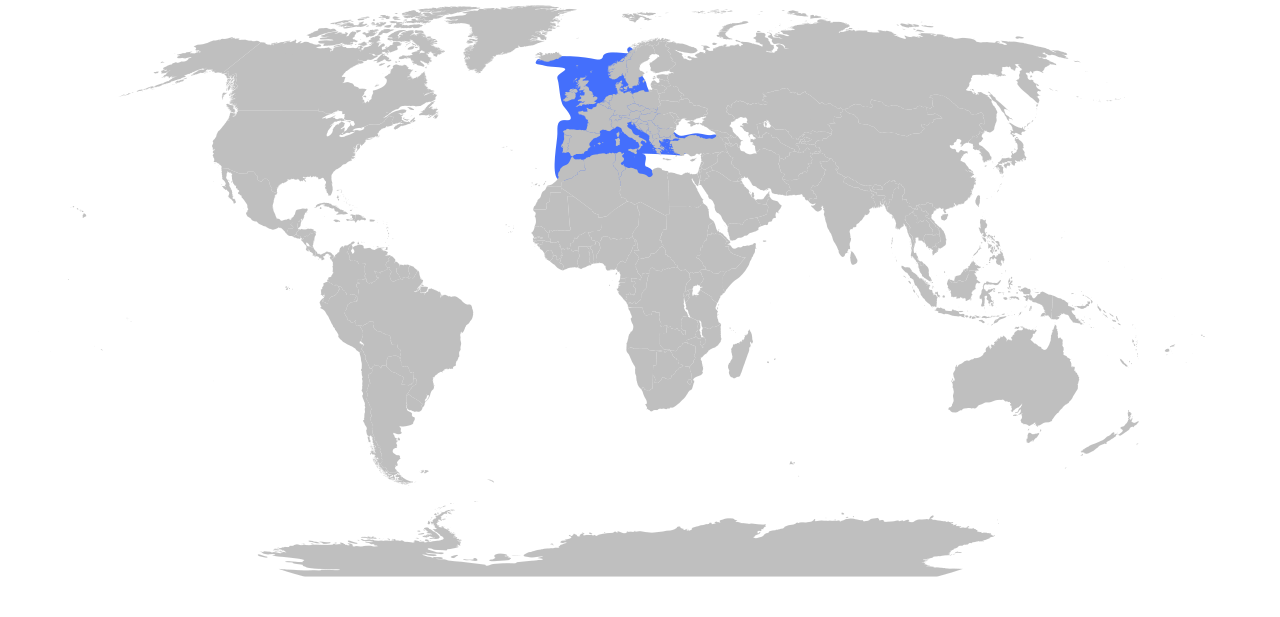
Anglerfish are found in every ocean on Earth, occupying an extraordinary range of habitats. Most are demersal, hugging the seafloor, but the deep-sea seadevils are pelagic, drifting high in the water column. Some, like frogfishes and certain batfishes, thrive in relatively shallow waters, while others, such as sea toads, inhabit the abyss. Fossil evidence pushes their origins far back: the earliest known anglerfish fossils come from the Eocene Monte Bolca formation in Italy, already showing diversification into lineages recognizable as modern families. Because their close relatives, the Tetraodontiformes, are known from Cretaceous fossils, researchers infer anglerfish likely originated during the Cretaceous. A 2010 mitochondrial genome study placed their major diversification between 130 and 100 million years ago, while a 2023 preprint narrows that window to the Late Cretaceous, roughly 92 to 61 million years ago. Other researchers argue they radiated only after the Cretaceous-Paleogene extinction as part of a broader percomorph adaptive radiation. Phylogenetic work consistently positions Lophiiformes as the sister group to Tetraodontiformes, united by shared derived features such as restricted gill openings and the loss of skeletal elements including ribs, nasals, and the basisphenoid.
Gallery
Frequently Asked Questions
What is an anglerfish?
Anglerfish are a group of ray-finned fish in the order Lophiiformes, best recognized by their signature hunting tool: a modified dorsal fin ray that dangles above the mouth to attract prey. They inhabit oceans worldwide, with most species living on or near the seafloor while deep-sea members drift in open water.
How does an anglerfish's lure work?
The lure is built from a specialized fin ray called the illicium, capped by a bioluminescent organ known as the esca that mimics a small food item to draw in unsuspecting animals. This trick is especially effective in the dim conditions of the deep sea, where natural light is nearly absent.
What is sexual parasitism in anglerfish?
In many deep-sea species, males are thousands of times smaller than females and, once a male locates a mate, he fuses permanently to her body, gradually losing his independent organs and becoming essentially a dedicated sperm sac. This extreme size disparity is one of the most dramatic examples of sexual dimorphism in the animal kingdom.
What is the largest anglerfish species?
The European monkfish (Lophius piscatorius) holds the record, reaching up to 200 cm in standard length and weighing as much as 57.7 kg. It is also the species most often sold in markets under names like monkfish or goosefish.
When did anglerfish first appear in the fossil record?
The earliest known anglerfish fossils come from the Monte Bolca formation in Italy and date to the Eocene epoch, placing their origin roughly 50 million years ago. This makes them an ancient and well-established lineage of ray-finned fish.
More in Fish 1-24
Elsewhere in the Fish universe
Spotted an error? Know more?
This is a living reference — every entry is fact-audited, and reader corrections feed straight into our audit queue. Suggest an edit · See this site's audit record