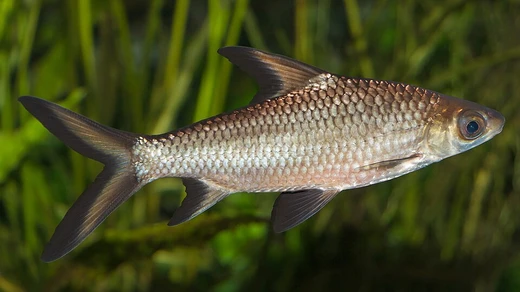
Milkfish
Sole living species of the ancient family Chanidae.
The milkfish (*Chanos chanos*) is a ray-finned fish spread across the Indo-Pacific. It stands as the only living species in the family Chanidae and the sole surviving member of the genus *Chanos*. Its scientific name is a tautonym, coming from the Greek word for "mouth." This fish belongs to the order Gonorhynchiformes, with its closest relatives being the Ostariophysi—a group that includes carps, catfish, and loaches. People call it by many names: *awa* in Hawaii, *ava* in Tahiti, *bangús* in the Philippines, *ibiya* in Nauru, and *bandeng* or *bolu* in Indonesia. Although it is often referred to as the national fish of the Philippines, the National Commission for Culture and the Arts points out that this title has no legal foundation.
**Geographic distribution**
*Chanos chanos* inhabits the Indian and Pacific Oceans, from South Africa all the way to Hawaii and the Marquesas, from California to the Galapagos, north to Japan, and south to Australia. A single individual turned up in the eastern Mediterranean Sea in 2012. In 1877, the California Fish and Game Commission brought 100 milkfish from Hawaii to inland waters in Solano County, California. That introduced population never became permanent, and what effect it had on the local ecosystem remains unclear. These fish usually live in tropical offshore marine waters near islands and along continental shelves, at depths of 1 to 30 meters. They also commonly move into estuaries and rivers.
**Taxonomy**
The genus *Chanos* is the last survivor of the ancient family Chanidae, a lineage that has been around since the Early Cretaceous. The only species still alive is *C. chanos*. The genus first appeared in North America, with the oldest known fossil coming from the earliest Paleocene, roughly 63 million years ago in Mexico. The earliest *Chanos* fossils come from freshwater Eocene deposits in Europe and North America, hinting that the species first evolved in freshwater environments 40–50 million years ago. It may have moved into the ocean during high sea-level periods or floods after the Eocene. Global cooling in the Mid-Eocene likely wiped out milkfish in the Atlantic, but the species held on in the Indo-Pacific. Known fossil species of *Chanos* include *C. brevis*, *C. chautus*, *C. compressus*, *C. forcipatus*, *C. torosus*, and *C. zignoi*. The extinct *Caeus leopoldi* from the Early Cretaceous of Italy is sometimes lumped into *Chanos* as *C. leopoldi*, which would make it the earliest record of the genus, but newer studies confirm it belongs to a separate genus.
**Anatomy**
Milkfish can reach up to 1.80 meters in length, though they are usually no longer than 1 meter, and can weigh about 19 kilograms in pond settings. They can live as long as 15 years. Their body is elongated, somewhat compressed, symmetrical, and streamlined, with a single dorsal fin, falcate pectoral fins, and a large forked tail fin. The head is small compared to the body, and the mouth is tiny and lacks teeth. The body is olive green, with silvery sides and fins edged in dark color. They have 13 to 17 dorsal soft rays, 8 to 10 anal soft rays, and 31 rays in the caudal fin. Many fine intramuscular bones run through the flesh, which can make eating the fish tricky (see "Consumption" below).
Their silvery look resembles many other Indo-Pacific fish. People often mistake them for species of Clupeidae, *Megalops cyprinoides*, *Gonorhynchus gonorhynchus*, and *Elops machnata*. *Chanos* can be told apart by its size, lack of scutes, a tubercle on the lower jaw, fin placement, no gular plate between the lower jaw arms, and only four branchiostegal rays.
Odd body types have turned up now and then. A "goldfish-type" milkfish found in the Philippines has unusually long dorsal, pelvic, and anal fins, plus a tail fin as long as its body. In Hawaii, Indonesia, and Australia, dwarf or hunchback "shad-type" specimens have been recorded, with a standard length-to-depth ratio of 2.0–2.5 instead of the usual 3.5–4.0. In northern Australia, a milkfish with a red head, red fins, and blue back has been reported.
**Life history**
How milkfish reproduce in the wild is much less understood than how they are bred in captivity (see "Aquaculture" below). In nature, milkfish take 3 to 5 years to mature. Females can produce between 0.5 and 6 million eggs and can spawn more than once a year. Spawning happens at night, may follow a lunar cycle, and is strongly seasonal. Milkfish eggs float in open water and range from 1.1 to 1.25 millimeters in diameter. Spawning sites are clear, warm, shallow waters over sand or coral reefs. It is thought they pick these spots to reduce predation from bottom-feeding planktivores.
Milkfish larvae go through a pelagic, planktonic stage. Younger larvae mostly stay near the surface, or sometimes deeper (down to 30 meters). Older larvae are found only at the surface and in nearshore areas. Larvae then change into fry and become bottom-feeding juveniles that eat plants, detritus, or a mix of foods, depending on what is available in their habitat.
Juvenile milkfish larger than about 5 centimeters generally look like adults. They have fully formed fin rays and a forked tail fin.
- Scientific name
- Chanos chanos
- Family
- Chanidae
- Maximum length
- 1.80 m (5 ft 11 in)
- Maximum weight
- About 19 kg (42 lb) in pond
- Maximum age
- 15 years
- Known for
- Sole living species of its family and genus; widely farmed in aquaculture
Lore & Background
The milkfish is the only surviving species of the genus Chanos, which originated in North America. The oldest known fossil of the genus dates to the earliest Paleocene around 63 million years ago in Mexico. The earliest fossil Chanos were found in freshwater Eocene deposits in Europe and North America, suggesting the species first appeared in freshwater environments 40–50 million years ago. Global cooling during the Mid-Eocene likely wiped out milkfish in the Atlantic, but the species persisted in the Indo-Pacific. Milkfish can grow to 1.80 m but are most often no more than 1 m in length. They have an elongated, compressed body, a small toothless mouth, and are olive green with silvery flanks. They are omnivorous opportunistic feeders, with juveniles eating phytoplankton, zooplankton, and small invertebrates, while adults also consume benthic invertebrates and planktonic items. Reproduction in the wild is less understood than in captivity; females can produce 0.5–6 million eggs and spawn more than once a year, with spawning taking place at night in clear, warm, shallow waters.
Reader's Guide
The milkfish holds significance as the sole living representative of the ancient family Chanidae, which has existed since the Early Cretaceous. Its wide geographic distribution across the Indo-Pacific, from South Africa to Hawaii and from California to the Galapagos, demonstrates remarkable adaptability. The species is extremely euryhaline and can inhabit marine waters, estuaries, and rivers. Despite genetic variation across populations, all are considered one species with low genetic diversity. Milkfish are important in aquaculture, particularly in Southeast Asia, though wild stocks are not threatened according to the IUCN. However, they face risks from pollutants and microplastics, as studies in the Philippines and Indonesia have found contaminants in their tissues. The species also has a notable fossil record, with extinct species known from Europe, North America, and Turkmenistan, providing insight into its evolutionary history.
Did You Know?
- The repeating scientific name Chanos chanos is from Greek khanos (χάνος 'mouth').
- Variant body types include a 'goldfish-type' in the Philippines and a dwarf 'shad-type' in Hawaii, Indonesia, and Australia.
Frequently Asked Questions
Who is Milkfish?
Milkfish (Chanos chanos) is a ray-finned fish native to the Indo-Pacific region. It is the only surviving member of both the family Chanidae and the genus Chanos, making it a taxonomic singleton with no close living relatives.
What makes Milkfish unique in the fish world?
Milkfish stands alone as the sole living representative of its entire family and genus, lineages that once included other species now long extinct. This makes it a kind of living fossil, with no close kin anywhere in the ocean.
How big can Milkfish get?
Under farm-pond conditions, individuals can reach roughly 1.8 metres in length and weigh around 19 kilograms. In the wild they typically stay smaller, though the species can live up to about 15 years.
What are Milkfish's common names around the world?
Depending on the region you'll hear it called awa in Hawaii, ava in Tahiti, bangús in the Philippines, ibiya in Nauru, and bandeng or bolu in Indonesia. The English name 'milkfish' is the most widely used common name internationally.
Is Milkfish officially the national fish of the Philippines?
Although it is popularly referred to as such and holds deep cultural significance there, the National Commission for Culture and the Arts has clarified that no Philippine law actually designates it as the national fish. The title is a cultural tradition rather than a legal one.
More in Fish 1-24
Spotted an error? Know more?
This is a living reference — every entry is fact-audited, and reader corrections feed straight into our audit queue. Suggest an edit · See this site's audit record