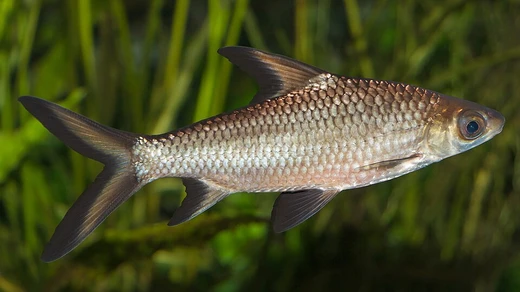
Ilish
An anadromous fish vital to South Asian cuisine and economy.
The ilish (Tenualosa ilisha), also known as hilsa, is a species of fish in the family Clupeidae, related to herring. It is the national fish of Bangladesh and the state fish of West Bengal, India, and is highly sought after as food in the Bengal region and beyond. This anadromous fish inhabits marine, brackish, and freshwater environments, migrating up rivers to spawn during the southwest monsoon seasons. Females grow larger than males, reaching lengths of up to 60 centimeters, while males mature at smaller sizes. The fish is silver with gold and purple hues when alive, and its fins are hyaline with no dorsal spines. It filter-feeds on plankton, including diatoms, green algae, and crustaceans, with juveniles relying more heavily on crustaceans. Ilish is found in eleven countries, including Bangladesh, India, Myanmar, and parts of the Middle East, but Bangladesh dominates global supply, accounting for 97% of the world’s catch as of 2023. The fish contributes significantly to Bangladesh’s economy, representing about 12% of total fish production and 1.15% of GDP, with roughly 450,000 people directly involved in fishing and millions more in related trade. It was declared a Geographical Indication of Bangladesh in 2017. Ilish is an oily fish rich in omega-3 fatty acids, and while numerous attempts have been made to breed it in captivity since the 1900s, its life cycle has not been successfully completed in controlled conditions. It is prepared in many ways, particularly in Bengali cuisine, where dishes like Shorshe Ilish are popular, and the fish is celebrated for its size and subtle taste, especially those caught in Bangladeshi waters.
- Scientific name
- Tenualosa ilisha
- Family
- Clupeidae
- National fish of
- Bangladesh
- State fish of
- West Bengal, India
- Maximum female length
- 55 cm
- Maximum male length
- 46 cm
- Percentage of world supply from Banglade
- 97%
Lore & Background
The ilish is an anadromous species, inhabiting pelagic-neritic, brackish, and freshwater habitats up to depths of about 200 m. It is found in 11 countries, including Bangladesh, India, Myanmar, Pakistan, Iran, Iraq, and others. The fish spawns in rivers during the southwest monsoons (June to September and January to April), ascending 50–100 km upstream, though the exact peak breeding season is debated. After spawning, most return to the sea, while some stocks remain resident in rivers. Females grow larger than males, reaching up to 55 cm, while males do not exceed 46 cm. Maturity is generally attained by the end of the first year or start of the second. The fish is silver with gold and purple hues when alive, with a dark blotch behind the gill opening and a series of small spots along the flank in juveniles. It filter feeds on plankton, primarily diatoms, green algae, and crustaceans. The fish was declared a Geographical Indication of Bangladesh on 6 August 2017.
Reader's Guide
The ilish holds immense cultural, economic, and dietary significance in South Asia, especially in Bangladesh and the Indian states of West Bengal, Odisha, and Andhra Pradesh. It is an oily fish rich in omega-3 fatty acids, and experiments have shown beneficial effects in decreasing cholesterol and insulin levels in rats. Bengali cuisine features ilish in numerous preparations, including Shorshe Ilish (mustard seed curry), and it can be smoked, fried, steamed, or baked. In Andhra Pradesh, the larger migratory hilsa called 'pulasa' from the Godavari River is considered a delicacy and commands high prices. Overfishing is a major concern, driven by high demand and advanced fishing techniques. Fines for catching juvenile 'jatka' have been imposed in Bangladesh, but this has led to unemployment and a black market. Environmental degradation, pollution, and global warming have further depleted breeding grounds. Bangladesh has periodically restricted ilish exports, though occasional gifts to India during Durga Puja—termed 'Hilsa Diplomacy'—have occurred. Despite efforts since the 1900s, the fish's life cycle has not been completed in captivity.
Did You Know?
- The ilish is known by many names, including jatka, palla, pulasa, terubok, and sboor.
- Females can reach up to 55 cm, while males do not exceed 46 cm.
- The fish contributes about 1.15% of Bangladesh's GDP.
- Ilish was declared a Geographical Indication of Bangladesh on 6 August 2017.
Frequently Asked Questions
What is Ilish?
Ilish (Tenualosa ilisha) is a migratory fish in the herring family, Clupeidae, best known by its common name 'hilsa.' It is the species that anchors Bengali fish culture and is officially recognized as the national fish of Bangladesh and the state fish of West Bengal, India.
What makes Ilish's life cycle special?
Ilish is anadromous, meaning it spawns in the ocean and then swims upstream into rivers to feed and mature. This sea-to-river migration is central to both its ecology and to the seasonal fishing traditions of South Asia.
How big does Ilish get?
Females are the larger sex, reaching up to 55 cm, while males max out at roughly 46 cm. That size gap is consistent across the species and is one of the quick ways to tell the sexes apart.
Why is Ilish such a big deal in Bengali cuisine?
It is arguably the most sought-after edible fish across the Bengal region and much of South Asia, driving a major portion of local cooking traditions and a significant share of the regional fishery economy. Its rich, oily flavor is considered unmatched by other clupeid species.
What family does Ilish belong to, and what else is in it?
Ilish sits in Clupeidae, the same family that houses herring, sardines, and menhaden. All members are small-to-medium schooling forage fish that form a critical base layer in their respective aquatic food webs.
More in Fish 1-24
Spotted an error? Know more?
This is a living reference — every entry is fact-audited, and reader corrections feed straight into our audit queue. Suggest an edit · See this site's audit record