Guppy
Small livebearing fish native to South America, widely introduced worldwide.
The guppy (Poecilia reticulata), also called the millionfish or rainbow fish, belongs to the Poeciliidae family and, like most New World members of that group, is a livebearer. Males are smaller than females and sport decorative tail and dorsal fins. In the wild, guppies eat a mix of foods, including bottom-dwelling algae and the larvae of aquatic insects. Their native range is northeastern South America, but they have been introduced worldwide and are now among the most widespread tropical fish and a staple of freshwater aquariums. Highly adaptable, they thrive in many different environments and are used as model organisms in ecology, evolution, and behavior research.
Taxonomy has shifted over time. Wilhelm Peters first described the species as *Poecilia reticulata* in Venezuela in 1859, while De Filippi named it *Lebistes poecilioides* in Barbados in 1861. Albert Günther later called it *Girardinus guppii* after Robert John Lechmere Guppy, who sent specimens from Trinidad to London’s Natural History Museum. Regan reclassified it as *Lebistes reticulatus* in 1913, but in 1963 Rosen and Bailey returned it to the original name, *Poecilia reticulata*. Despite these changes, “guppy” remains the common name, even though *Girardinus guppii* is now a junior synonym.
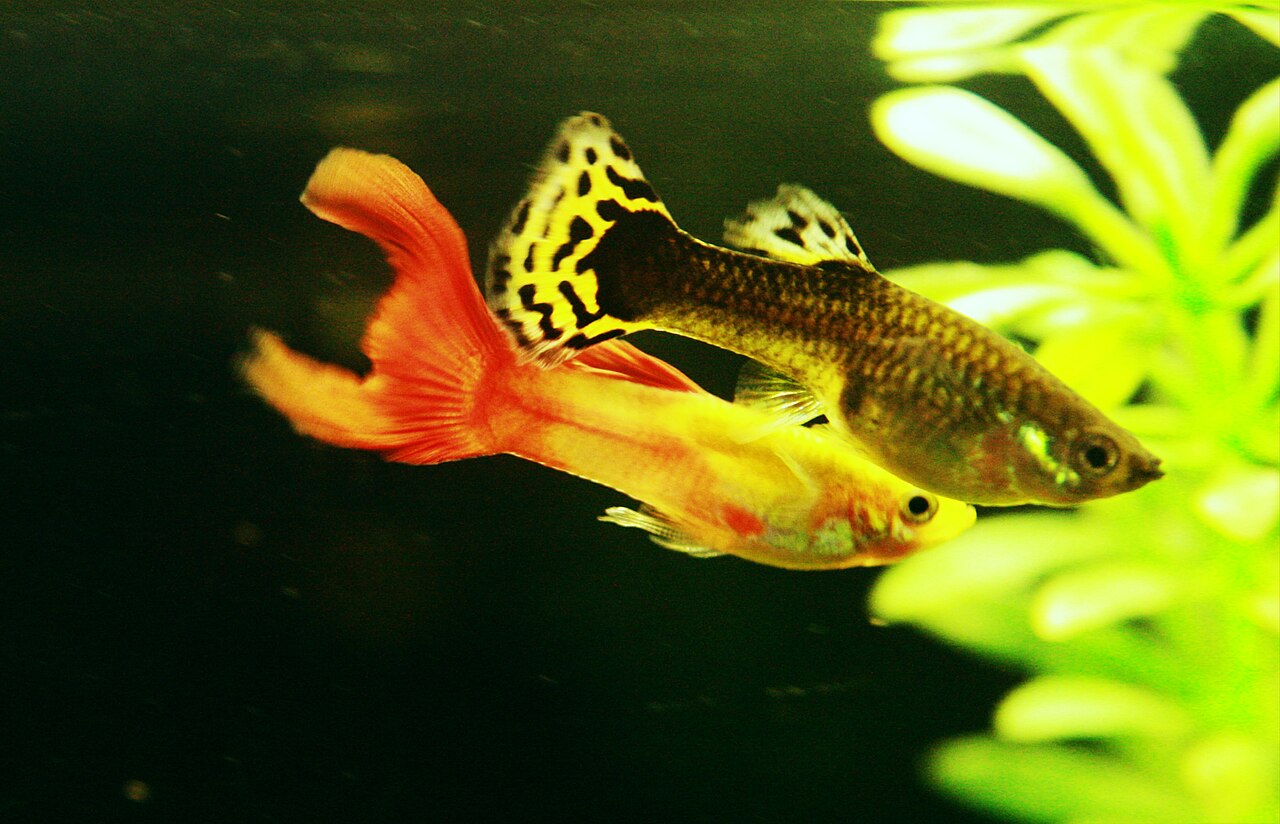
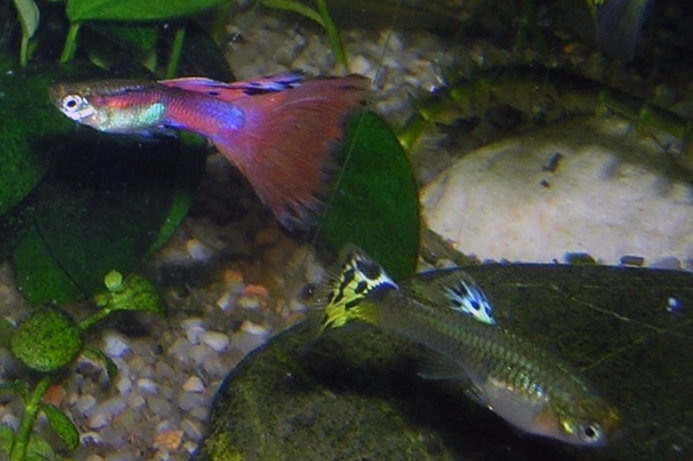
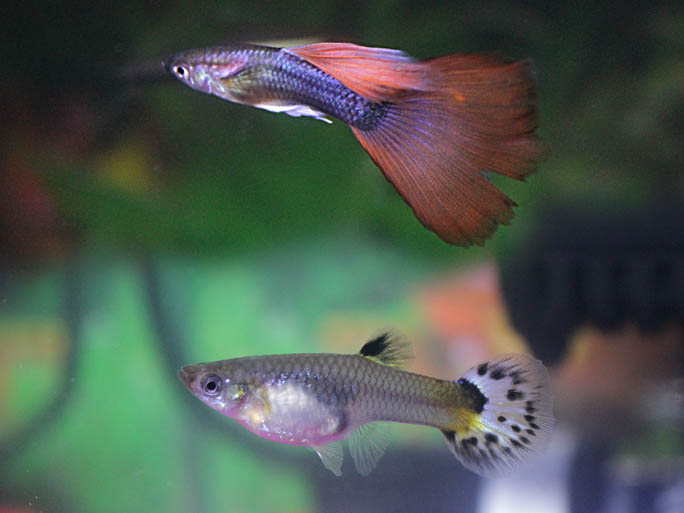
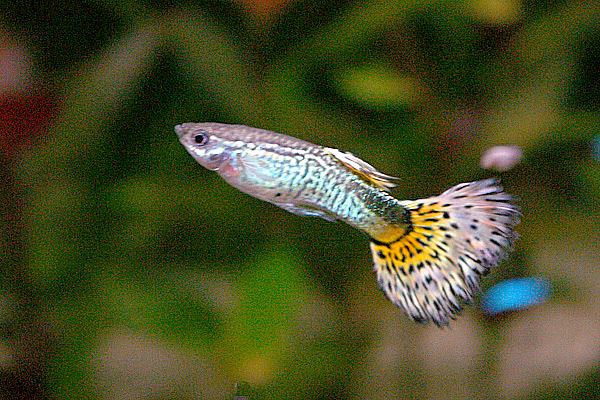
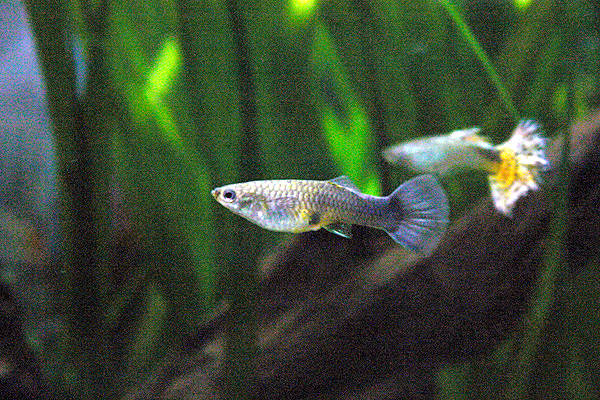
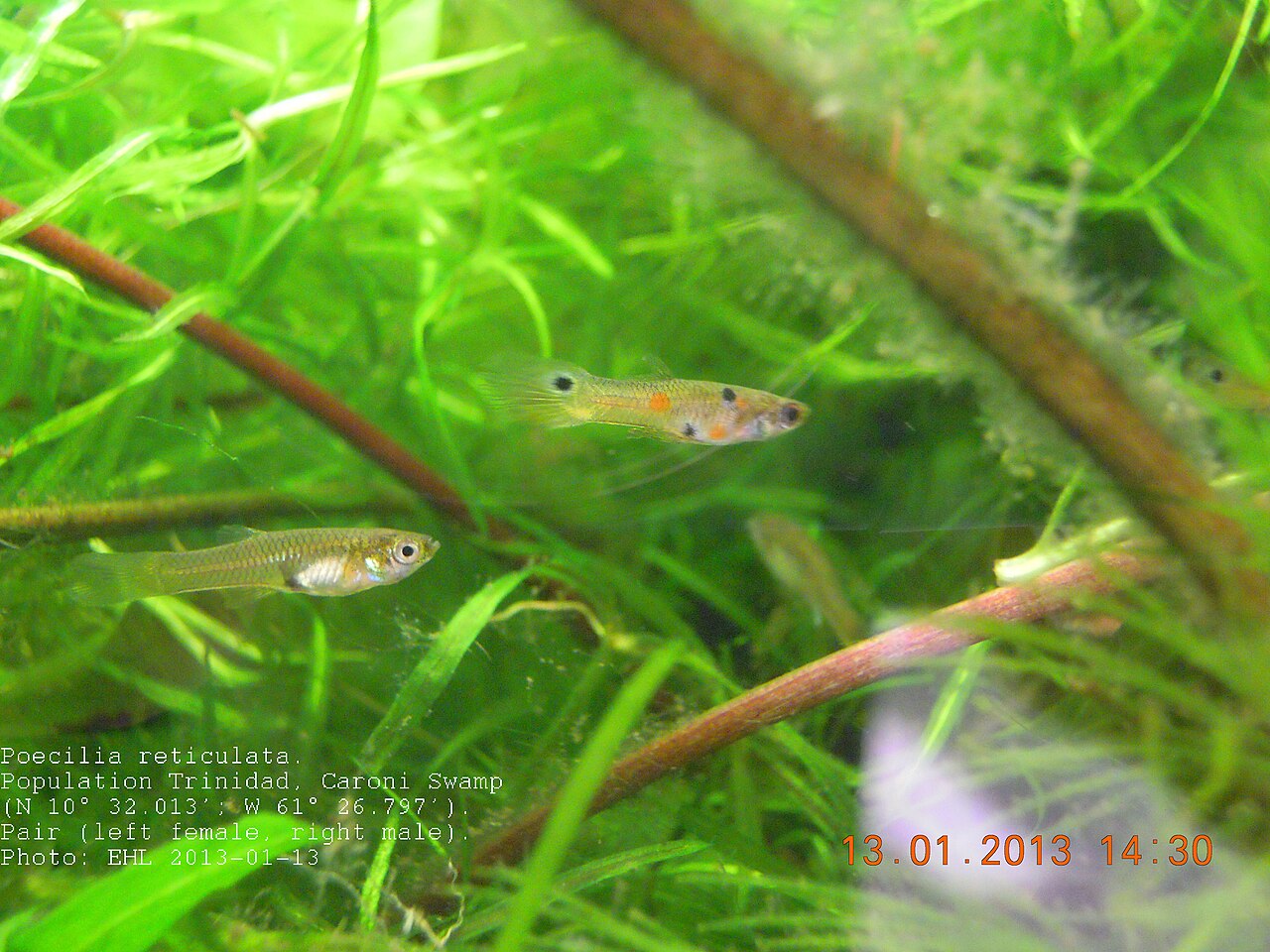
Sexual dimorphism is pronounced. Wild-type females are grey, while males display splashes, spots, or stripes in many colors. Thyroid hormone levels influence both the development of these color patterns and the fish’s endocrine response to its environment. Males typically grow 1.5–4 cm long, females 3–7 cm. Through selective breeding, hobbyists have created fancy guppy strains—such as snakeskin and grass varieties—with distinct colors, patterns, and fin shapes. Many domestic strains are larger and more ornate than their wild ancestors.
Native to Antigua and Barbuda, Barbados, Brazil, Guyana, Trinidad and Tobago, and Venezuela, guppies have been introduced to every continent except Antarctica, often accidentally or for mosquito control. They were expected to eat mosquito larvae and curb malaria, but in many places they have harmed native fish populations. In their natural ranges, guppies occupy almost every accessible freshwater body, especially coastal streams in South America. They can tolerate brackish water and have colonized some such environments, and they can even acclimate to full saltwater like their molly relatives. They are most common in small streams and pools rather than large, deep, or fast rivers.
Wild guppies eat algae, diatoms, invertebrates, zooplankton, detritus, plant fragments, mineral particles, and aquatic insect larvae. Algae usually makes up the largest portion of their diet, but this varies by habitat. For instance, in Trinidad, guppies from an upstream oligotrophic area (upper Aripo River) ate mostly invertebrates, while those from a downstream eutrophic area (lower Tacarigua River) ate mostly diatoms and mineral particles. Algae is less nutritious than invertebrates, so algae-heavy diets are poorer. Guppies have also been seen eating native fish eggs and, in lab settings, occasionally cannibalizing their own young.
Diet preference isn’t simply tied to food abundance. Lab experiments show guppies exhibit “diet switching,” feeding disproportionately on whichever food is more abundant when given two choices, but different groups have weak and variable preferences. Preference may relate to competition: in the lower Tacarigua River, where more species compete for invertebrates, guppies eat fewer of them. Guppies often forage in groups, finding food more easily. Shoaling guppies spend less time and energy on antipredator behavior and more on feeding, though they share found food. Studies also show that when there is an evolutionary cost, shoaling guppies are less aggressive and competitive over scarce resources. Shoaling is thus preferred in high-predation areas but not in low-predation ones. When guppies from high-predation regions were moved to predator-free environments, they gradually reduced shoaling, supporting the idea that shoaling is less favored where predators are absent.
Guppies face many predators, including larger fish.
- Native range
- Brazil, Guyana, Trinidad and Tobago, Venezuela
Lore & Background
It was named Girardinus guppii by Albert Günther in honour of Robert John Lechmere Guppy, who sent specimens from Trinidad to the Natural History Museum in London. Guppies exhibit sexual dimorphism: wild-type females are grey, while males display splashes, spots, or stripes of various colours, influenced by thyroid hormone levels. Males are typically 1.5–4 cm long, females 3–7 cm. Breeders have produced many fancy strains through selective breeding, with distinct colours, patterns, and fin shapes.
Reader's Guide
Guppies are significant as a model organism in ecology, evolution, and behavioural studies due to their adaptability and wide distribution. They have been introduced globally, often for mosquito control, but sometimes negatively impact native fish populations. Their diet varies widely, including algae, diatoms, invertebrates, and insect larvae, and they exhibit diet-switching behaviour. Guppies face predation from larger fish and birds, and their colouration and schooling behaviour evolve in response to predation pressure. They perform predator inspection and have a unique predator diversion tactic where their irises darken to draw attacks to the head, allowing rapid escape. Guppies also host a range of parasites. Their role in scientific research, particularly in understanding sexual selection, predator-prey dynamics, and behavioural ecology, makes them a key species in biological studies.
Did You Know?
- Male guppies are smaller than females and have ornamental caudal and dorsal fins.
- Guppies have been introduced to every continent except Antarctica, often for mosquito control.
- Guppies show 'diet switching' behaviour, feeding disproportionately on the more abundant food when given two choices.
A Century of Taxonomic Turmoil
The scientific identity of the guppy has been anything but settled. In 1859, Wilhelm Peters first described the species from Venezuela under the name Poecilia reticulata, while two years later De Filippi published a separate description from Barbados as Lebistes poecilioides. The common name "guppy" traces back to Albert Günther, who honoured Robert John Lechmere Guppy—the individual who shipped specimens from Trinidad to London's Natural History Museum—by coining the binomial Girardinus guppii. Yet the classification story did not end there. Regan reclassified the fish as Lebistes reticulatus in 1913, and it was not until 1963 that Rosen and Bailey restored the original Poecilia reticulata designation. This repeated reshuffling produced a long string of synonyms, with Girardinus guppii now formally regarded as a junior synonym. Despite all the taxonomic churn, the everyday name "guppy" has endured as the one term the species is universally known by, a rare case where a common name outlived every scientific label attached to it.
Sexual Dimorphism and the Art of Selective Breeding
Guppies display one of the most striking examples of sexual dimorphism in the freshwater world. Wild females present as plain grey-bodied fish measuring roughly three to seven centimetres, while males—typically only one and a half to four centimetres long—carry ornamental caudal and dorsal fins adorned with splashes, spots, or stripes in an almost limitless palette of colours. Remarkably, thyroid hormone levels govern both the development and expression of these male colour patterns and simultaneously regulate endocrine responses to environmental conditions. In the aquarium trade, breeders have pushed this natural variation far beyond anything seen in the wild. Through generations of selective breeding, strains such as snakeskin and grass varieties now exhibit dramatically larger body sizes and far more elaborate fin ornamentation than their wild-type ancestors. The morphological gap between a wild Trinidad guppy and a show-quality domestic male is so vast that the two could almost be mistaken for different species, yet both carry the same Poecilia reticulata genome.
From Malaria Control to Ecological Disruption
Native to a handful of Caribbean islands and northeastern South American countries—including Antigua and Barbuda, Barbados, Brazil, Guyana, Trinidad and Tobago, and Venezuela—the guppy has since been introduced to freshwater systems on every continent except Antarctica. The most common reason for these introductions was practical: guppies were released to consume mosquito larvae and thereby help curb the spread of malaria. In their native coastal streams and small pools, guppies thrive and colonise nearly every accessible freshwater body, and they even tolerate brackish water and can be acclimated to full saltwater, much like their molly relatives. However, the well-intentioned mosquito-control programme carried a hidden cost. In many introduced locations, guppies have exerted negative pressure on native fish populations, disrupting local ecosystems they were never part of. Their extraordinary adaptability—tolerating a wide range of ecological conditions and outcompeting less flexible species—makes them one of the most widely distributed tropical fish on Earth, yet that same adaptability is precisely what turns a beneficial introduction into an ecological problem.
Shoaling, Diet Switching, and the Economics of Foraging
Guppy foraging behaviour reveals a sophisticated balance between feeding efficiency and predation risk. In the wild, their diet is remarkably flexible, encompassing algal remains, diatoms, invertebrates, zooplankton, detritus, plant fragments, mineral particles, and aquatic insect larvae. Yet preference is not fixed: laboratory experiments confirm a "diet switching" pattern in which guppies disproportionately consume whichever food source is most abundant when given a choice. In Trinidad, guppies from nutrient-poor upstream stretches of the Aripo River fed mainly on invertebrates, while those from the nutrient-rich lower Tacarigua River shifted toward diatoms and mineral particles—partly because intense competition from a greater variety of species made invertebrate prey harder to secure. Group foraging amplifies food-finding efficiency and reduces the time and energy spent on antipredatory vigilance, but it also means sharing what is found. Evolution favours shoaling in high-predation environments, and when guppies with a strong shoaling tendency are transplanted into predator-free habitats, their group-feeding behaviour gradually diminishes over time, confirming that the strategy is context-dependent rather than innate.
Gallery
Frequently Asked Questions
What is a guppy?
The guppy (Poecilia reticulata) is a tiny, brightly colored freshwater fish in the Poeciliidae family. It is a livebearer, so females deliver fully formed, free-swimming fry rather than laying eggs.
Where are guppies originally from?
Their native range covers northeastern South America, including Brazil, Guyana, Trinidad and Tobago, and Venezuela. Through human introduction they have spread to tropical waterways on every continent and are now one of the most geographically widespread freshwater fish.
Why do people call guppies 'millionfish'?
The nickname reflects how explosively their populations can grow. Because they are livebearers that produce large litters of fry at a young age, a single pair can generate what looks like a million offspring in a well-stocked tank or pond.
What makes guppies important to science?
They are a standard model organism in ecology, evolutionary biology, and behavioral research. Their rapid generation cycles, striking color polymorphism, and ease of laboratory husbandry let researchers study natural selection, mate-choice dynamics, and adaptation in real time.
Why are guppies such a staple in home aquariums?
They are small, forgiving of water-quality fluctuations, and available in a huge spectrum of color and fin shapes. Combined with their low cost and wide availability, that makes them one of the most popular beginner tropical freshwater species worldwide.
More in Fish 1-24
Spotted an error? Know more?
This is a living reference — every entry is fact-audited, and reader corrections feed straight into our audit queue. Suggest an edit · See this site's audit record