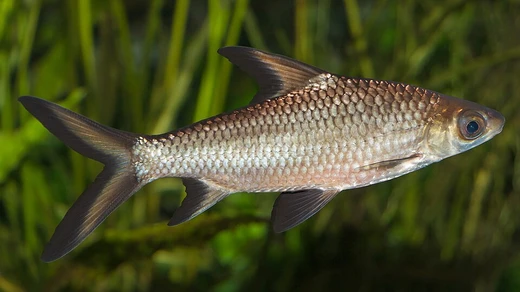
Milkfish
Sole living species of the ancient family Chanidae.

The milkfish (Chanos chanos) is a widespread species of ray-finned fish found throughout the Indo-Pacific. It is the sole living species in the family Chanidae and the only living member of the genus Chanos. The species has many common names, including awa in Hawaiian, ava in Tahitian, bangús in the Philippines, ibiya in Nauruan, and bandeng or bolu in Indonesia. It is popularly known as the national fish of the Philippines, though the National Commission for Culture and the Arts has stated this has no basis in Philippine law.
- Scientific name
- Chanos chanos
- Family
- Chanidae
- Maximum length
- 1.80 m (5 ft 11 in)
- Maximum weight
- About 19 kg (42 lb) in pond
- Maximum age
- 15 years
- Known for
- Sole living species of its family and genus; widely farmed in aquaculture
Lore & Background
The milkfish is the only surviving species of the genus Chanos, which originated in North America. The oldest known fossil of the genus dates to the earliest Paleocene around 63 million years ago in Mexico. The earliest fossil Chanos were found in freshwater Eocene deposits in Europe and North America, suggesting the species first appeared in freshwater environments 40–50 million years ago. Global cooling during the Mid-Eocene likely wiped out milkfish in the Atlantic, but the species persisted in the Indo-Pacific. Milkfish can grow to 1.80 m but are most often no more than 1 m in length. They have an elongated, compressed body, a small toothless mouth, and are olive green with silvery flanks. They are omnivorous opportunistic feeders, with juveniles eating phytoplankton, zooplankton, and small invertebrates, while adults also consume benthic invertebrates and planktonic items. Reproduction in the wild is less understood than in captivity; females can produce 0.5–6 million eggs and spawn more than once a year, with spawning taking place at night in clear, warm, shallow waters.
Reader's Guide
The milkfish holds significance as the sole living representative of the ancient family Chanidae, which has existed since the Early Cretaceous. Its wide geographic distribution across the Indo-Pacific, from South Africa to Hawaii and from California to the Galapagos, demonstrates remarkable adaptability. The species is extremely euryhaline and can inhabit marine waters, estuaries, and rivers. Despite genetic variation across populations, all are considered one species with low genetic diversity. Milkfish are important in aquaculture, particularly in Southeast Asia, though wild stocks are not threatened according to the IUCN. However, they face risks from pollutants and microplastics, as studies in the Philippines and Indonesia have found contaminants in their tissues. The species also has a notable fossil record, with extinct species known from Europe, North America, and Turkmenistan, providing insight into its evolutionary history.
Did You Know?
- The repeating scientific name Chanos chanos is from Greek khanos (χάνος 'mouth').
- Variant body types include a 'goldfish-type' in the Philippines and a dwarf 'shad-type' in Hawaii, Indonesia, and Australia.
Frequently Asked Questions
Who is Milkfish?
Milkfish (Chanos chanos) is a ray-finned fish native to the Indo-Pacific region. It is the only surviving member of both the family Chanidae and the genus Chanos, making it a taxonomic singleton with no close living relatives.
What makes Milkfish unique in the fish world?
Milkfish stands alone as the sole living representative of its entire family and genus, lineages that once included other species now long extinct. This makes it a kind of living fossil, with no close kin anywhere in the ocean.
How big can Milkfish get?
Under farm-pond conditions, individuals can reach roughly 1.8 metres in length and weigh around 19 kilograms. In the wild they typically stay smaller, though the species can live up to about 15 years.
What are Milkfish's common names around the world?
Depending on the region you'll hear it called awa in Hawaii, ava in Tahiti, bangús in the Philippines, ibiya in Nauru, and bandeng or bolu in Indonesia. The English name 'milkfish' is the most widely used common name internationally.
Is Milkfish officially the national fish of the Philippines?
Although it is popularly referred to as such and holds deep cultural significance there, the National Commission for Culture and the Arts has clarified that no Philippine law actually designates it as the national fish. The title is a cultural tradition rather than a legal one.
More in Fish 25-40
Elsewhere in the Fish universe
Spotted an error? Know more?
This is a living reference — every entry is fact-audited, and reader corrections feed straight into our audit queue. Suggest an edit · See this site's audit record