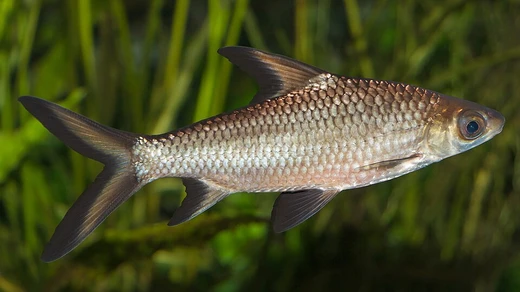
Herring
Forage fish forming large schools, vital to fisheries science and history.

Herring are various species of forage fish belonging to the order Clupeiformes. They often move in large schools around fishing banks and near the coast, found particularly in shallow, temperate waters of the North Pacific and North Atlantic Oceans, including the Baltic Sea, as well as off the west coast of South America. Herring played an important role in the history of marine fisheries in Europe, and early in the 20th century, their study was fundamental to the development of fisheries science.
- type
- Forage fish
- order
- Clupeiformes
- family
- Clupeidae
- primary_species
- Atlantic herring (Clupea harengus) and Pacific herring (Clupea pallasii)
- typical_size
- 14 to 46 cm (5.5 to 18 in) depending on subspecies
- habitat
- Shallow, temperate waters of North Pacific, North Atlantic, Baltic Sea, and west coast of South America
- known_for
- Forming large schools; important food fish often salted, smoked, or pickled
Lore & Background
The origins of the term 'herring' may derive from the Old High German 'heri' meaning a 'host, multitude', in reference to the large schools they form. The type genus Clupea contains only two species: the Atlantic herring and the Pacific herring. Subspecific divisions have been suggested for both, but their biological basis remains unclear. Herring were also known as 'silver darlings' in the United Kingdom. Herring are silvery-coloured fish with a single soft dorsal fin, no lateral line, and a protruding lower jaw. Their size varies: Baltic herring are 14 to 18 cm, Atlantic herring can grow to about 46 cm and weigh up to 700 g, and Pacific herring grow to about 38 cm. At least one stock of Atlantic herring spawns in every month of the year, with eggs laid on the sea bed on rock, stones, gravel, sand, or algae. The larvae are 5 to 6 mm at hatching and become transparent, with only the eyes well pigmented. Herring consume copepods, arrow worms, pelagic amphipods, mysids, and krill. They feed on phytoplankton when young and later on zooplankton. During daylight, they stay in deep water for safety, feeding at the surface at night. They use both particulate feeding and filter feeding, depending on prey concentration. Copepods are a major prey item; herring hunt them in synchronized grids, exploiting the copepods' escape jump timing.
Reader's Guide
Herring have been a cornerstone of European marine fisheries and early 20th-century fisheries science. Their study helped establish the foundations of modern fisheries management. As an oily fish, they have long been an important food fish, commonly preserved by salting, smoking, or pickling. The Atlantic herring alone comprises over half of all herring capture, and three species of Clupea account for about 90% of all herrings captured in fisheries. Their ecological role is central: they are a key prey item for higher trophic levels, while themselves consuming copepods and other zooplankton. The species' ability to form huge, fast-cruising schools contributes to their dominance. Their life cycle, with spawning occurring year-round in different stocks, and their precise feeding behaviors—such as ram feeding on copepods—demonstrate sophisticated adaptations. The term 'herring' can vary locally, with some species called herring in one region but something else elsewhere. This complexity underscores the need for careful taxonomic and ecological study, which continues to inform conservation and fishery practices.
Did You Know?
- Herring were known as 'silver darlings' in the United Kingdom.
- The term 'herring' may derive from Old High German 'heri' meaning a 'host, multitude', referring to their large schools.
- Atlantic herring can grow to about 46 cm and weigh up to 700 g.
- Herring larvae are nearly transparent at hatching, with only the eyes well pigmented.
Frequently Asked Questions
What kind of fish is Herring?
Herring are small forage fish classified under the order Clupeiformes and family Clupeidae. They're best known for swimming in massive, tightly packed schools near coastal areas.
Where can I find Herring in the wild?
These fish favor shallow, temperate coastal waters, with the most notable populations in the North Atlantic, North Pacific, the Baltic Sea, and along South America's western coast.
How big do Herring grow?
Depending on the subspecies, adult herring typically range from about 14 to 46 centimeters (roughly 5.5 to 18 inches) in length.
What are the main species of Herring?
The two primary species most people refer to are the Atlantic herring (Clupea harengus) and the Pacific herring (Clupea pallasii), though the broader group includes several related forage species.
Why do Herring matter to fisheries science?
Herring were central to European marine fishing traditions for centuries, and their population dynamics became a cornerstone of early 20th-century fisheries research. Studying their schooling behavior and migration patterns helped establish the scientific framework still used to manage fish stocks today.
More in Fish 25-40
Elsewhere in the Fish universe
Spotted an error? Know more?
This is a living reference — every entry is fact-audited, and reader corrections feed straight into our audit queue. Suggest an edit · See this site's audit record