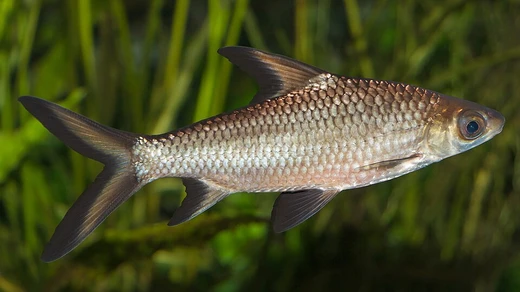
European seabass
A commercially important temperate bass native to European and African coasts.

Bjoertvedt · CC BY-SA 4.0
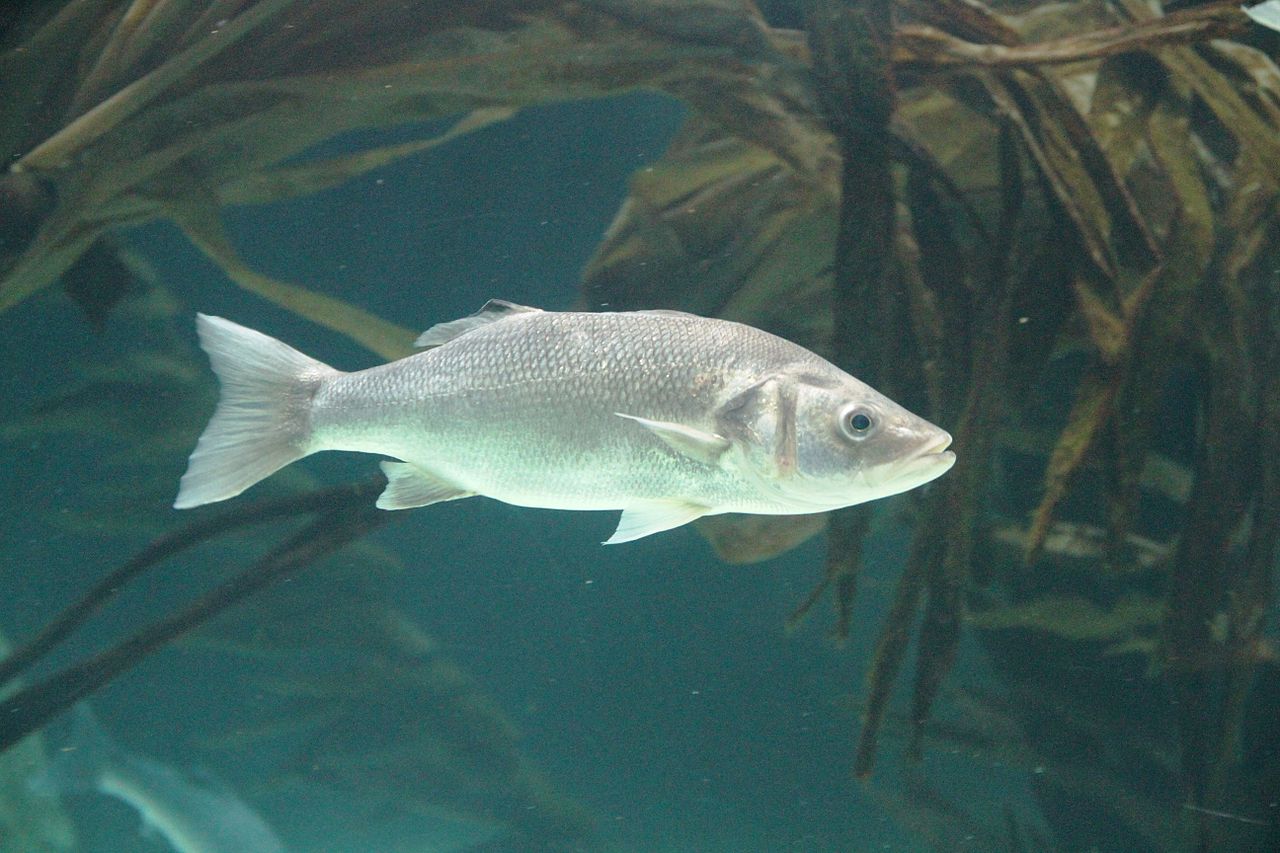
The European seabass (Dicentrarchus labrax), also known as branzino, European bass, sea bass, common bass, white bass, capemouth, white salmon, white mullet, sea dace, levrek or loup de mer, is a primarily ocean-going fish native to the waters off Europe's western and southern and Africa's northern coasts. It is one of only six species in its family, Moronidae, collectively called the temperate basses. It is fished and raised commercially and is considered the most important fish currently cultured in the Mediterranean.
- Scientific name
- Dicentrarchus labrax
- Family
- Moronidae
- Native range
- Eastern Atlantic from southern Norway to Senegal, Mediterranean Sea, southern Black Sea
- Maximum length
- 1 m (3 ft 3 in)
- Maximum weight
- 12 kg (26 lb)
- Conservation status
- Near Threatened
Lore & Background
Its generic name derives from Greek, referring to the presence of two anal spines. There are two genetically distinct wild populations: one in the northeast Atlantic Ocean and another in the western Mediterranean Sea, separated by the Almeria-Oran oceanographic front east of the Spanish city of Almería. The reason for this separation is unknown, as the geographic divide should not account for the lack of gene flow between the two populations.
Reader's Guide
The European seabass is a slow-growing species that takes several years to reach adulthood, typically weighing around 2.5 kg (5 lb 8 oz) and reaching up to 1 m in length and 12 kg in weight. It is a seasonally migratory fish, moving to winter spawning grounds and then to summer feeding areas. Juveniles form schools and feed on invertebrates, while adults are less social and prefer other fish. It hunts both day and night, feeding on small fish, polychaetes, cephalopods, and crustaceans. The species is a sought-after game fish and is listed as Near Threatened by the International Union for Conservation of Nature due to a decreasing population. In Ireland, all commercial fishing is banned, and recreational anglers face restrictions including a closed season and bag limits.
Did You Know?
- The European seabass is one of only six species in the family Moronidae.
- Its generic name Dicentrarchus derives from Greek meaning 'two stings' referring to two anal spines.
- There are two genetically distinct wild populations separated by the Almeria-Oran oceanographic front.
- Farmed European seabass have been used to study the earliest genomic and epigenetic stages of de novo domestication.
A Name in Dozens of Tongues
Few fish in European waters carry as many names as the European seabass. Carl Linnaeus first catalogued the species in 1758 under the binomial Perca labrax in his landmark Systema Naturae, but the nomenclature remained unsettled for well over a century. It was not until 1987 that Dicentrarchus labrax became the universally accepted scientific designation. The genus name itself is a small piece of Greek anatomy: 'di' for two, 'kentron' for sting, and 'archos' for anus, a reference to the fish's two anal spines. Despite this settled taxonomy, the common-name chaos persists. Across the British Isles alone, the same fish appears on menus and in angling guides as European bass, common bass, capemouth, king of the mullets, sea dace, sea perch, white mullet, white salmon, or simply bass. In North American kitchens it is most often recognized by its Italian name, branzino. This linguistic sprawl reflects the species' long and deep entanglement with human food culture across the Mediterranean and Atlantic coasts, and it underscores that the European seabass is one of only six members of the temperate bass family, Moronidae.
Two Populations, One Mysterious Divide
Geneticists have identified two distinct wild populations of European seabass: one inhabiting the northeast Atlantic and the other occupying the western Mediterranean. The boundary between them falls along the Almeria-Oran oceanographic front, a relatively narrow zone east of the Spanish port city of Almería. What makes this split genuinely puzzling is that the geographic gap should not, on its own, prevent gene flow. The larval phase of the species can stretch to three months, during which the young are poor swimmers and even modest currents ought to carry some individuals across the divide. Juveniles tolerate shifts in temperature and salinity, and adults routinely travel hundreds of kilometres. Yet the two groups remain genetically separate for reasons scientists have not yet explained. In terms of seasonal rhythm, the fish is a migratory species: it moves to inshore waters between February and June for spawning, then heads toward summer feeding grounds near river mouths, lagoons, and estuaries, before retreating offshore for the winter. As newly hatched fry they drift in open water, but within a year or two they settle into estuarine habitats where they feed on prawns, crabs, and small fish before eventually maturing into less social, more predatory adults.
A Slow-Growing Fish Under Growing Pressure
Because European seabass is a slow-growing species that requires several years to reach adulthood, it is particularly vulnerable to sustained fishing pressure. The International Union for Conservation of Nature currently lists it as Near Threatened, a designation reflecting a measurable decline in wild populations. Annual wild catches between 2000 and 2009 hovered between 8,500 and 11,900 tonnes, with France consistently reporting the largest Atlantic harvests and Egypt overtaking Italy in the Mediterranean. A 2013 scientific advisory warned that fishing mortality was climbing, and the best available stock indicator showed total biomass in 2011–2012 was roughly 32 percent lower than in 2008–2010. In response, Ireland has banned all commercial fishing for the species outright and imposed tight recreational limits: a closed season from mid-May through mid-June, a minimum catch size of 400 millimetres, and a daily bag limit of just two fish. In the United Kingdom, recreational anglers have become the driving force behind conservation advocacy for the species. The combination of slow growth, increasing mortality, and declining biomass paints a picture of a fish that, despite its cultural importance, is losing ground in the wild.
From Tidal Lagoons to the World's Plates
European seabass was among the very first fish in Europe to be raised commercially. Long before modern aquaculture, people cultured the species in coastal lagoons and tidal reservoirs, but it was not until the late 1960s that mass-production techniques transformed it into a large-scale industry. Today it stands as the most important fish farmed in the Mediterranean, with Greece, Turkey, Italy, Spain, Croatia, and Egypt leading production. By 2010 annual output had surpassed 120,000 tonnes, and Turkey has emerged as the single largest producer worldwide. Beyond its commercial role, farmed European seabass has become a valuable model for studying the earliest genomic and epigenetic changes that occur during de novo domestication, capturing shifts that arise before farmed and wild populations become strongly differentiated. On the dining table, the fish holds a special place: in Ireland and the United Kingdom, the 'sea bass' on restaurant menus is exclusively this species, while in North America it is most commonly known by its Italian name, branzino. In southern Italy, where it is also called spigola, the classic preparation is a whole roasted fish served with lemon, a dish that has made the species a staple of Mediterranean cuisine.
Gallery
Frequently Asked Questions
Who is European seabass?
European seabass (Dicentrarchus labrax) is a temperate bass in the family Moronidae, one of only six species in that group. It is a primarily ocean-going fish that goes by many names—branzino, sea bass, loup de mer, white salmon, among others—but refers to a single species native to European and North African waters.
What are European seabass's powers/role?
As a predator, it can reach a maximum length of 1 metre (3 ft 3 in) and a weight of 12 kg (26 lb), making it a formidable top-feeder in its habitat. It also plays a dominant economic role as the most heavily farmed fish species in the Mediterranean.
How does European seabass's story end?
European seabass is currently listed as Near Threatened, signalling that it faces a growing risk of decline if existing pressures are not managed. Its narrative, however, is far from over, as it continues to be both wild-caught and aquacultured across its range.
Why is European seabass important?
It anchors the Mediterranean aquaculture industry as the single most important cultured fish there, supporting coastal economies from southern Norway all the way to Senegal. Its dual status as a wild-caught and farmed species makes it a linchpin of regional fisheries.
Where does European seabass live?
Its native range covers the Eastern Atlantic from southern Norway down to Senegal, the full extent of the Mediterranean Sea, and the southern portion of the Black Sea. It is a primarily ocean-going species favouring the western and southern European coasts as well as Africa's northern shores.
Elsewhere in the Fish universe
Spotted an error? Know more?
This is a living reference — every entry is fact-audited, and reader corrections feed straight into our audit queue. Suggest an edit · See this site's audit record