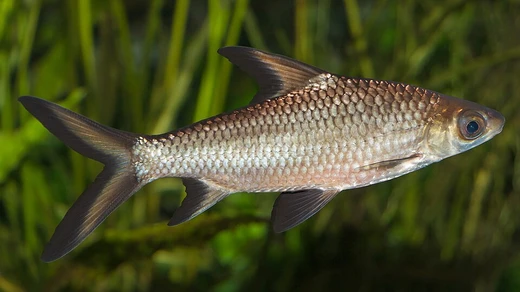
Haddock
A commercially vital North Atlantic gadoid with a distinctive black blotch.

Håkan Dahlström · CC BY 2.0
The haddock (Melanogrammus aeglefinus) is a saltwater ray-finned fish from the family Gadidae, the true cods. It is the only species in the monotypic genus Melanogrammus. Found in the North Atlantic Ocean and associated seas, it is an important species for fisheries, especially in northern Europe, where it is marketed fresh, frozen, and smoked; smoked varieties include the Finnan haddie and the Arbroath smokie.
- scientific_name
- Melanogrammus aeglefinus
- family
- Gadidae
- maximum_length
- 94 cm (37 in)
- maximum_weight
- 11 kg (24 lb)
- typical_length_UK
- 30 to 70 cm (12 to 27.5 in)
- typical_length_eastern_Canada
- 38 to 69 cm (15 to 27 in)
- lifespan
- around 14 years
Lore & Background
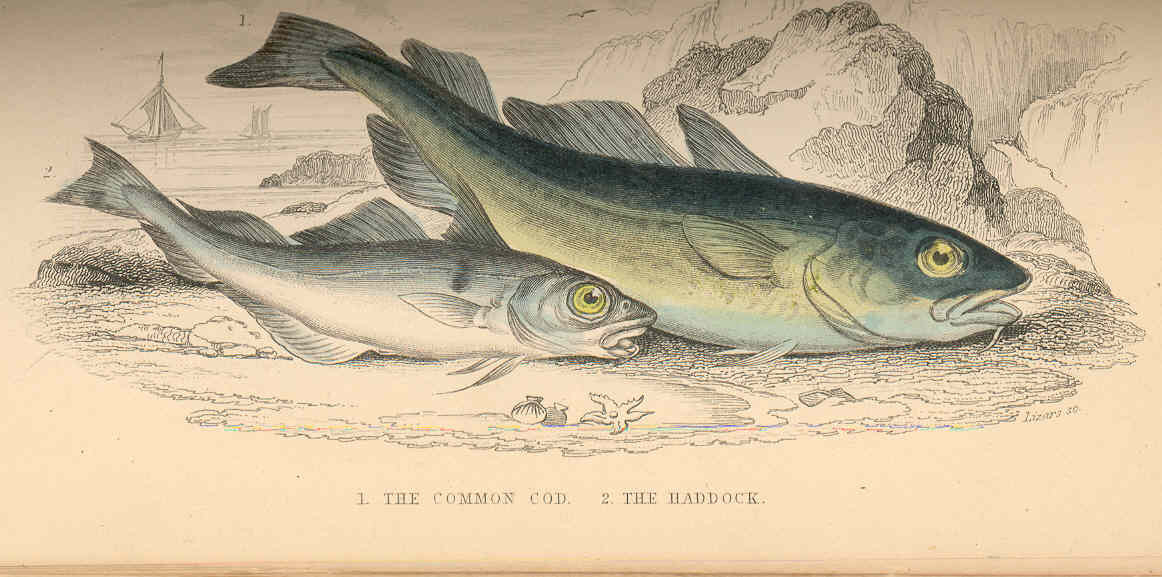
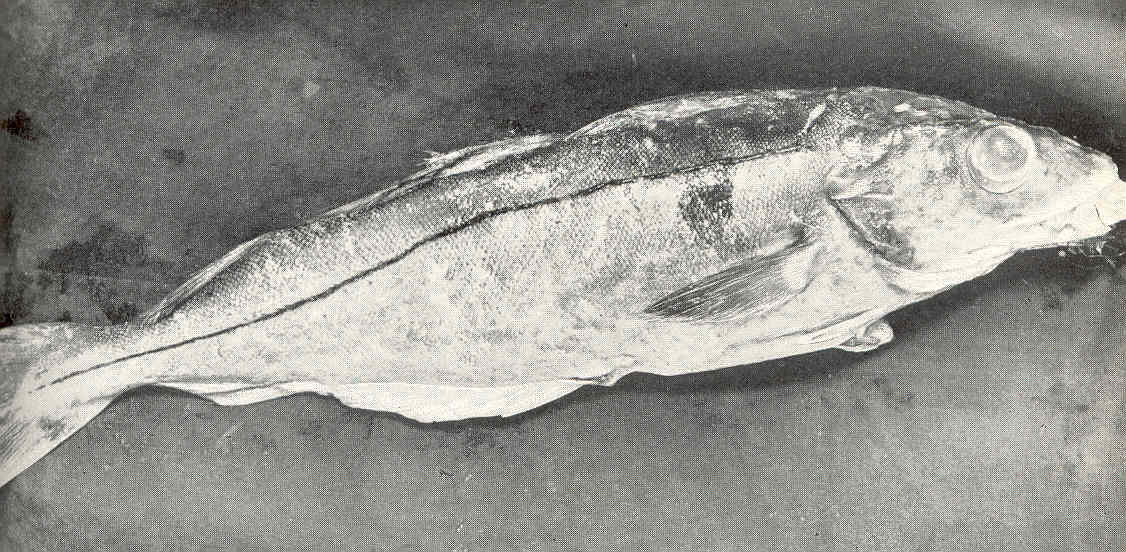
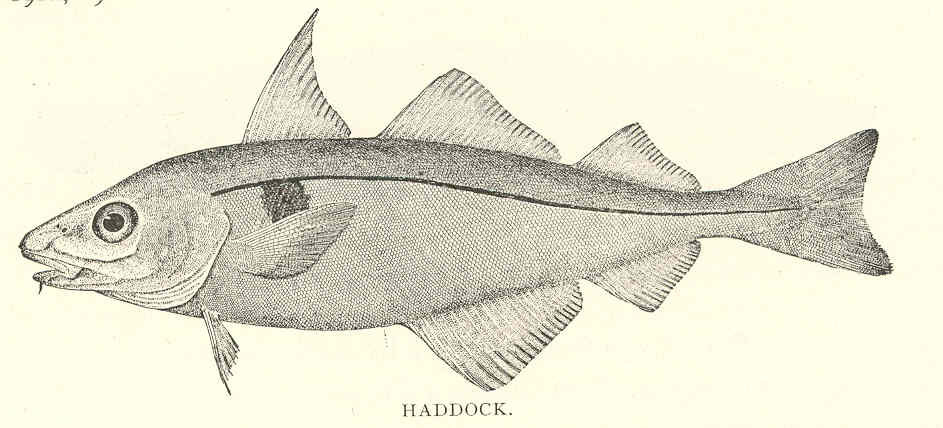
The haddock has the elongated, tapering body shape typical of members of the cod family. It has a relatively small mouth, a wedge-shaped snout, and a small barbel on the chin. It has three dorsal fins and two anal fins, all separated. The upper side varies from dark grey brown to nearly black, while the lower part is dull silvery white. A distinctive black lateral line curves slightly over the pectoral fins, and a black blotch or 'thumbprint' sits between the lateral line and the pectoral fin, giving the genus its name from Greek 'melanos' meaning 'black' and 'gramma' meaning letter or signal. It reaches sexual maturity at 4 years in males and 5 years in females, except in the North Sea where males mature at 2 years and females at 3 years. Spawning occurs from January to July in the northwestern Atlantic and February to June in the northeastern Atlantic. The eggs are pelagic, and after hatching, larvae remain pelagic until about 7 cm long, then settle to a demersal habit.
Reader's Guide
The haddock is a key species in North Atlantic fisheries, particularly in northern Europe, where it is marketed fresh, frozen, and smoked. Smoked varieties such as Finnan haddie and Arbroath smokie are culturally significant. The species has a distinctive appearance, including a black lateral line and a dark shoulder blotch, which aids identification. Its biology shows regional variation in growth, maturity, and migration patterns. The species is also a host to parasites such as the cod worm, Lernaeocera branchialis, which uses flatfish or lumpsucker as an intermediate host before attaching to haddock gills and penetrating the host's circulatory system. The haddock's importance to commercial fishing and its role in marine ecosystems make it a subject of ongoing study, particularly regarding changes in growth rates and recruitment.
Did You Know?
- The haddock is the only species in the monotypic genus Melanogrammus.
- It has a distinctive oval black blotch between the lateral line and pectoral fin, sometimes called the 'Devil's thumbprint'.
- The longest recorded haddock was 94 cm (37 in) and weighed 11 kg (24 lb).
- The cod worm, Lernaeocera branchialis, parasitizes haddock by penetrating the gills and entering the rear bulb of the host's heart.
The Devil's Thumbprint and Distinctive Anatomy
The haddock carries one of the most recognizable markings in the North Atlantic: a bold oval black blotch positioned between the lateral line and the pectoral fin. Commonly nicknamed the "Devil's thumbprint," this spot is the very feature that inspired the scientific genus name Melanogrammus, drawn from the Greek words for "black" and "letter" or "signal." Beyond this signature mark, the fish presents a sleek, tapering body typical of the true cod family, with a relatively small mouth and a wedge-shaped snout where the upper jaw projects noticeably past the lower. Three dorsal fins and two anal fins, all clearly separated from one another, give the haddock a distinctive fin architecture. Coloration runs from dark grey-brown or near-black along the back to a dull silvery white below, with a contrasting black lateral line that arcs slightly over the pectoral fins. Most individuals caught in UK waters fall between 30 and 70 centimetres, though a record specimen reached 94 centimetres and 11 kilograms. Rare variants with golden backs, barred patterns, or a missing shoulder blotch have also been documented.
Ranging the North Atlantic
The haddock occupies waters on both sides of the North Atlantic, yet its populations are noticeably denser in the eastern basin. In the northeast, its range stretches from the Bay of Biscay up to Spitzbergen, with peak concentrations north of the English Channel. It also ventures into Arctic waters around Novaya Zemlya and the Barents Sea. The largest discrete stocks sit in the North Sea, off the Faroe Islands, around Iceland, and along the Norwegian coast, though these groups show very little interchange with one another. On the North American side, haddock appear from western Greenland down to Cape Hatteras, with the principal commercial stock concentrated between Cape Cod and the Grand Banks of Newfoundland. As a demersal species, the haddock typically inhabits depths between 80 and 200 metres, though it has been recorded from 10 to 450 metres. It favours rocky, sandy, gravelly, or shell-strewn seabeds and thrives in water between 4 and 10 degrees Celsius. Migrations vary by region: off Iceland and in the Barents Sea the fish undertake extensive seasonal movements, while in the northwestern Atlantic their travel is more limited, largely tied to journeys to and from spawning grounds.
From Pelagic Egg to Demersal Adult
Haddock reach sexual maturity at roughly four years for males and five for females, though the North Sea population matures earlier, at two and three years respectively. Female fecundity scales dramatically with size: a 25-centimetre fish carries about 55,000 eggs, while a 91-centimetre specimen can hold nearly 1.84 million. Spawning occurs at depths of 50 to 150 metres, with the northeastern Atlantic season running from February through June and peaking in March and April, and the northwestern Atlantic season spanning January to July. The tiny pelagic eggs, just 1.2 to 1.7 millimetres across, take one to three weeks to hatch. Newly hatched larvae remain in the water column, feeding on immature copepods, ostracods, and limacina, before transitioning to larger pelagic prey such as amphipods, euphausiids, and zoea larvae of decapods. At roughly 7 centimetres in length, the young fish settle onto the seabed and gradually shift their diet toward benthic organisms. Growth is regionally variable, but a one-year-old may measure 17 to 19 centimetres, reaching 25 to 36 centimetres by age two and 75 to 82 centimetres at thirteen years. The overall lifespan hovers around fourteen years.
A Staple of Northern European Fisheries
As the sole member of the monotypic genus Melanogrammus and a member of the Gadidae family, the haddock holds a singular taxonomic position among saltwater ray-finned fish. Its economic importance is concentrated in northern Europe, where it ranks among the most commercially significant species in the North Atlantic fishery. In markets across the region, haddock is sold fresh, frozen, and in a variety of smoked preparations that have become well-known culinary products. The Finnan haddie and the Arbroath smokie are perhaps the most celebrated smoked haddock items, each a recognized name in the smoked-fish trade. Another well-known preparation, the long boneless, involves taking the filleted side of a larger haddock and smoking it over oak chips while leaving the skin attached to the fillet. These diverse processing methods reflect the fish's versatility and its long-standing role in the food culture of coastal communities. The species' abundance in discrete stocks across the North Sea, Faroe Islands, Iceland, and Norwegian waters has made it a cornerstone of local fishing economies.
Gallery



Frequently Asked Questions
What is a haddock?
The haddock is a saltwater ray-finned fish that belongs to the Gadidae family, the group commonly called the true cods. It stands alone as the sole species within the genus Melanogrammus, giving it a unique taxonomic slot.
Where do haddock live in the wild?
They are native to the North Atlantic Ocean and the seas connected to it. Populations are especially dense off the coasts of northern Europe and eastern Canada.
How big can a haddock get?
Under ideal conditions an individual can reach roughly 94 cm in length and tip the scales at about 11 kg. In UK waters most fish fall in the 30-to-70 cm range, while those caught off eastern Canada typically measure between 38 and 69 cm.
What is the easiest way to tell a haddock apart from other cods?
Look for the bold black blotch sitting on the upper flank; that spot is the species' signature field mark. Combined with its status as the only member of Melanogrammus, it separates haddock from its look-alike gadid relatives.
Why is the haddock so important to fisheries and cuisine?
It is a commercially vital catch throughout northern Europe, marketed fresh, frozen, and in smoked form. Two of the best-known smoked preparations are the Finnan haddie and the Arbroath smokie.
More in Fish 25-40
Elsewhere in the Fish universe
Spotted an error? Know more?
This is a living reference — every entry is fact-audited, and reader corrections feed straight into our audit queue. Suggest an edit · See this site's audit record